Getting started
Discovery and scope definition
The first stage was to map out the critical needs that the platform had to solve. Three priority areas emerged:
Sponsors and commercial: Fulfilling the commitments already made by guaranteeing visibility and interaction opportunities with participants.
Content coordination: Coordinating multiple simultaneous conference rooms, schedules, access, and speaker participation from different locations.
Administrative management: Managing registrations, ticket sales, access control, and live stream coordination.
With time as our main constraint, we evaluated the available options together with the development team and the streaming company. Building a completely custom platform from scratch was not feasible in five months, so we opted for a hybrid solution: an external tool to guarantee streaming stability and room management, and custom development for the commercial areas and the welcome experience.
Initial proposals
We worked on three rounds of wireframes to quickly validate critical needs and main flows before moving forward with the final design and development.
We faced two main challenges during this phase. The first was sponsor visibility, as they needed a clear brand presence and opportunities for interaction within the platform. The second was replicating the dynamics of the in-person event in the digital environment, which meant accounting for questions to the moderator, audience participation, slide sharing, and the management of sessions with multiple speakers. These validation sessions with the commercial and content teams allowed us to align criteria.


Challenges along the way
Key features
To structure the platform, we divided the experience into three main user profiles, ensuring that each had the necessary tools to achieve their goals during the event:
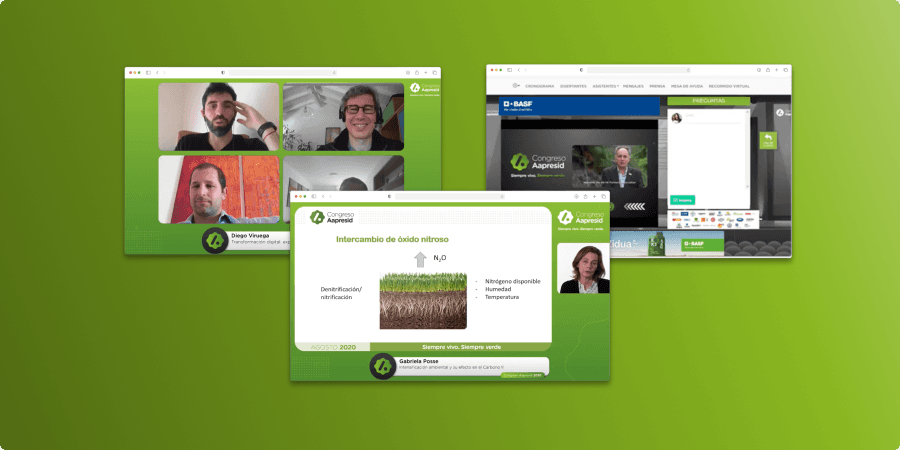
Attendees: We designed a seamless registration flow and centralized access to the full event schedule. From there, users could enter workshops and conferences, actively participate in debates, and ask questions to the moderator. We also included search tools to locate specific companies or speakers, and a member support module to receive live assistance throughout the congress.
Companies (Sponsors): To fulfill commercial commitments, we guaranteed their strategic visibility within the workshop and conference rooms. Additionally, we designed dedicated pages (microsites) where they could showcase product content, along with networking tools to locate and connect with event attendees.
Speakers: We created a dedicated, frictionless space for their registration and secure login. This profile featured tools to upload and share presentations (slides), as well as a panel to interact with the audience and answer questions in real-time during their sessions.
Design and development: design under pressure
Designing with only a five-month margin and an unmovable date completely changed our decision-making process.
The first major challenge was creating a seamless experience across two different systems. We had to connect our custom-built platform—designed specifically to give sponsors high visibility—with the external streaming tool. The goal was for attendees to navigate between the conferences and the commercial stands without noticing they were jumping from one system to another.
The second critical moment was the speakers' experience. The content team detected that the technical friction of the digital environment could become a real operational problem during the event. To mitigate this, we simplified the access flow to the absolute minimum and designed a step-by-step preparation guide. Although it was not part of the original scope, it was vital to ensure the event flowed without interruptions.
Coordination with other departments
Aligning the proposal with the administration, finance, and member support teams revealed a new challenge: processes that flowed informally in person now required explicit digital design.
The clearest example was member support. At the physical event, inquiries were resolved instantly at a booth. To maintain that immediacy in the digital environment, we designed a dedicated module with key information and a live chat, replicating the proximity of face-to-face interactions throughout the event.
Furthermore, coordination with the speakers and the streaming team drove critical interface improvements: we adjusted room access times, designed status messages for waiting periods, and optimized how attendees were notified about last-minute changes.

Results & Impact
The event in numbers
The Aapresid 2020 Congress took place over 9 days divided into two weeks: Networking Week from August 18 to 21, and Knowledge Week from August 24 to 28. With 8 simultaneous rooms per day, the event brought together 11,500 registrants, doubling the historical figures of the in-person format, and generated 21,913 total accesses to the platform.
Going virtual allowed us to break geographic barriers in a way the in-person format never had before: 552 speakers participated, 95 of whom were international—a record number facilitated by the elimination of travel costs. In total, 365 talks and workshops were delivered.
Beyond the numbers, the organization's assessment was definitive: the board of directors described the event as an absolute success and highlighted that many of the digital components would be permanently adopted.
Learnings
Working under such tight deadlines forced us to prioritize ruthlessly. During the first few weeks, we focused almost entirely on ensuring the technical viability of the workshops and conferences, as well as fulfilling the sponsors' commercial needs.
However, my biggest takeaway was organizational: we should have involved the administration, finance, and member support teams much earlier in the process. By not including them during the discovery phase, we overlooked the fact that much of the in-person experience relied on informal processes they managed directly. Bringing them in from the start would have allowed us to map out operational needs and frictions that we, from a purely technical and commercial perspective, were completely blind to at the time.